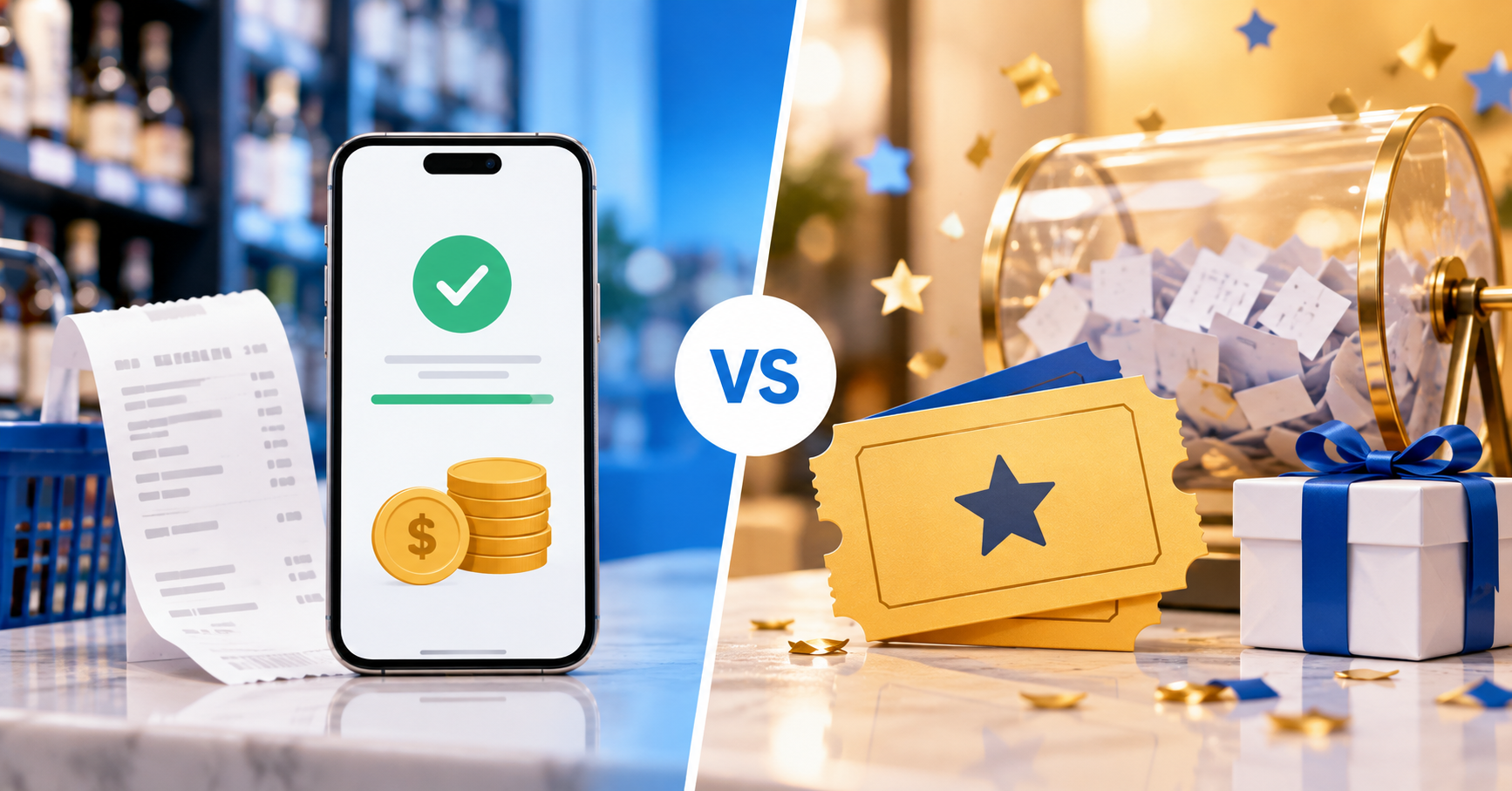
A rebate and a sweepstakes both get a shopper to do something at shelf. That is where the similarity ends. They cost differently, they measure differently, and they reach different people.
**Choose a rebate when you need measurable sell-through.**
A rebate requires a purchase. Every entry is a receipt, which means every entry is proof that a bottle left a shelf. You can count units, identify the retailer, see the transaction date and know how many qualifying products were in the basket.
That makes a rebate the right instrument when the question is whether the programme moved volume. One Irish whiskey campaign produced 1,283 bottles sold, a 25% lift against the prior year, and 847 paid submissions, every one traceable to a validated receipt. Those are not modelled figures.
The cost structure follows from the mechanic. You pay per qualifying purchase, so budget scales with success. That is comfortable if volume is the objective and uncomfortable if the budget is fixed.
**Choose a sweepstakes when you need reach.**
A sweepstakes does not require a purchase, and in most states it legally cannot. That removes the friction and widens the funnel considerably. Cost is fixed at the prize, so the budget does not scale with participation.
What you give up is proof. A sweepstakes entry tells you someone was interested. It does not tell you whether a bottle moved.
**They reach different people, which is the part most brands miss.**
A rebate, by design, only ever reaches people who have already bought the bottle. A sweepstakes, with no purchase required, reaches people who have not bought it yet. That is the strongest practical argument for running both rather than choosing between them. If a brand's rebate programme is converting current buyers efficiently, a sweepstakes is not a duplicate spend. It is access to people the rebate is not reaching.
**A working framework**
Use a rebate when you need to prove sell-through, when you are defending shelf space with data, when the budget can flex with volume, or when the objective is a first-party list of confirmed buyers.
Use a sweepstakes when you need awareness at the top of the funnel, when the budget must be fixed and known in advance, when the prize itself carries brand meaning, or when you are trying to reach beyond your current buyer.
Use both when the year has room for it, and measure them against different questions. Judging a sweepstakes on sell-through will make it look like a failure. Judging a rebate on reach will do the same in reverse.